Mediation Analysis
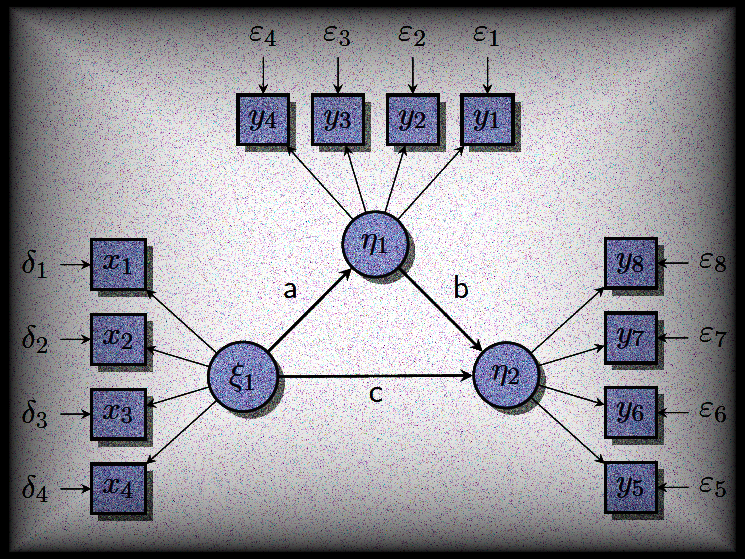
Mediation analysis is a widely popular topic in psychology and is often used to help explain the relationship between two variables in terms of an additional (mediating) variable. This line of research focuses on how to best do inference and confidence interval formation with regression-based and latent variable mediation analysis models (e.g., structural equation and multilevel models). Much of this work overlaps with situations where there is missing/nonnormal data, and includes extensive simulations conducted on high performance computing clusters. There is a pressing need for further integrating this work with how to test causal assumptions in research with quasi-experimental designs as well as continue to provide researchers with access to the most advanced methods for longitudinal models.
Representative Publications
Falk, C. F., Vogel, T. A., Hammami, S., & Miočević, M. (2024). Multilevel mediation analysis in R: A comparison of resampling and Bayesian approaches. Behavior Research Methods, 56, 750-764. doi: 10.3758/s13428-023-02079-4
[Preprint] [OSF] [R Package (CRAN)] [R Package (GitHub)]Falk, C.F. (2018). Are robust standard errors the best approach for interval estimation with non-normal data in structural equation modeling? Structural Equation Modeling: A Multidisciplinary Journal, 25, 244-266. doi: 10.1080/10705511.2017.1367254
[Supplementary Materials]- Won Research Award from the Quantitative Methods Section of the Canadian Psychological Association (2019)
Falk, C.F., & Biesanz, J.C. (2016). Two cross-platform programs for inferences and interval estimation about indirect effects in mediational models. SAGE Open, 6. doi: 10.1177/2158244015625445
Falk, C.F., & Biesanz, J.C. (2015). Inference and interval estimation methods for indirect effects with latent variable models. Structural Equation Modeling: A Multidisciplinary Journal, 22, 24-38. doi: 10.1080/10705511.2014.935266
Biesanz, J.C., Falk, C.F., & Savalei, V. (2010). Assessing mediational models: Testing and interval estimation for indirect effects. Multivariate Behavioral Research, 45, 661-701. doi: 10.1080/00273171.2010.498292